Are plant proteins just as effective?
Can plant proteins really build muscle mass? What the research shows about leucine, digestibility and hypertrophy.
A deeply held belief
For a long time, the answer seemed to leave no room for doubt. To build muscle, you had to favour animal proteins. Eggs, chicken, fish and dairy products sat at the centre of recommendations, while plant proteins were relegated to the background. They were criticised for being incomplete, less digestible and unable to support the same muscular adaptations.
This belief has stayed deeply rooted in the world of strength training. Even today, many trainees hesitate to adopt a vegetarian or vegan diet for fear of compromising their performance. Others see plant proteins as a mere add-on, acceptable for ethical or environmental reasons, but physiologically inferior.
Yet this view no longer really reflects the current state of knowledge. In recent years, several clinical trials, systematic reviews and meta-analyses have reassessed the question by directly comparing the adaptations obtained with animal versus plant proteins in people doing resistance training.
Their conclusion is more nuanced than the debate itself. Animal proteins retain certain nutritional advantages, but these aren't enough to conclude that a plant-based diet would prevent muscle growth. In most situations, it's less the origin of a protein that determines results than the overall quality of the diet, total daily intake, and consistency of training.
The question is no longer which protein is best, but understanding what actually makes a muscle grow.
Why do proteins play such an important role?
After a strength training session, the body doesn't immediately try to build more muscle. Its priority is first to repair the tissue that was stressed during training.
Repeated contractions create mechanical stress that the body responds to by renewing the proteins that make up muscle fibres. When this process is repeated over weeks, alongside progressive training and sufficient nutritional intake, it gradually leads to an increase in muscle mass.
Dietary proteins supply the amino acids needed for this reconstruction. Of the twenty amino acids used by the body, nine are called essential: the body can't manufacture them itself and depends entirely on food to obtain them.
One of them draws particular attention from researchers: leucine. It acts as a metabolic signal capable of stimulating muscle protein synthesis after a meal. Proteins containing more of it generally trigger a stronger response for the same quantity. This is precisely one of the reasons animal proteins have long been considered superior.
Why do animal proteins enjoy this reputation?
Animal proteins do indeed have several favourable characteristics. They naturally provide all nine essential amino acids in proportions close to human needs. Their digestibility is also high, meaning that a large share of the protein consumed is actually absorbed and then used by the body.
These qualities earn them excellent scores in modern protein-quality assessment methods, such as DIAAS (Digestible Indispensable Amino Acid Score).
At first glance, the conclusion seems logical: if a protein is more digestible and contains more leucine, it should necessarily build more muscle. For a long time, this hypothesis seemed sufficient. But nutrition almost never works in such a simple way.
What the studies actually show
Early research often compared an animal protein with an isolated plant protein, consumed in the same amounts. Under these conditions, animal proteins did stimulate muscle protein synthesis more strongly immediately after ingestion. These results largely contributed to their reputation.
However, they have an important limitation: they describe the body's response after a single meal, not the adaptations observed after several months of training. Yet it isn't one meal that builds muscle, but the accumulation of hundreds of meals combined with hundreds of training sessions.
When researchers looked at results obtained over several weeks, the picture became much more interesting. Meta-analyses published in recent years show that, in adults doing resistance training and consuming enough protein, the differences between animal and plant proteins become far more modest.
Some analyses observe a slight advantage for animal proteins on certain lean-mass measures, particularly in adults under fifty. This advantage nonetheless remains small, and probably tends to shrink further when total protein intake is sufficient — though this hypothesis, at this stage, is more a reasonable extrapolation than a directly demonstrated finding. In other words, the overall quality of the diet appears to matter more than the origin of a protein consumed in isolation.
The role of leucine: important, but not sufficient
Leucine occupies a central place in this discussion, sometimes to the point of being given excessive importance. It's true that plant proteins often contain less of it than animal proteins. Wheat, rice or certain legumes reach the threshold considered optimal for stimulating post-meal protein synthesis less easily.
Does this mean they're insufficient? No. It simply means it may be necessary to adjust portions or favour certain plant sources that are richer in protein.
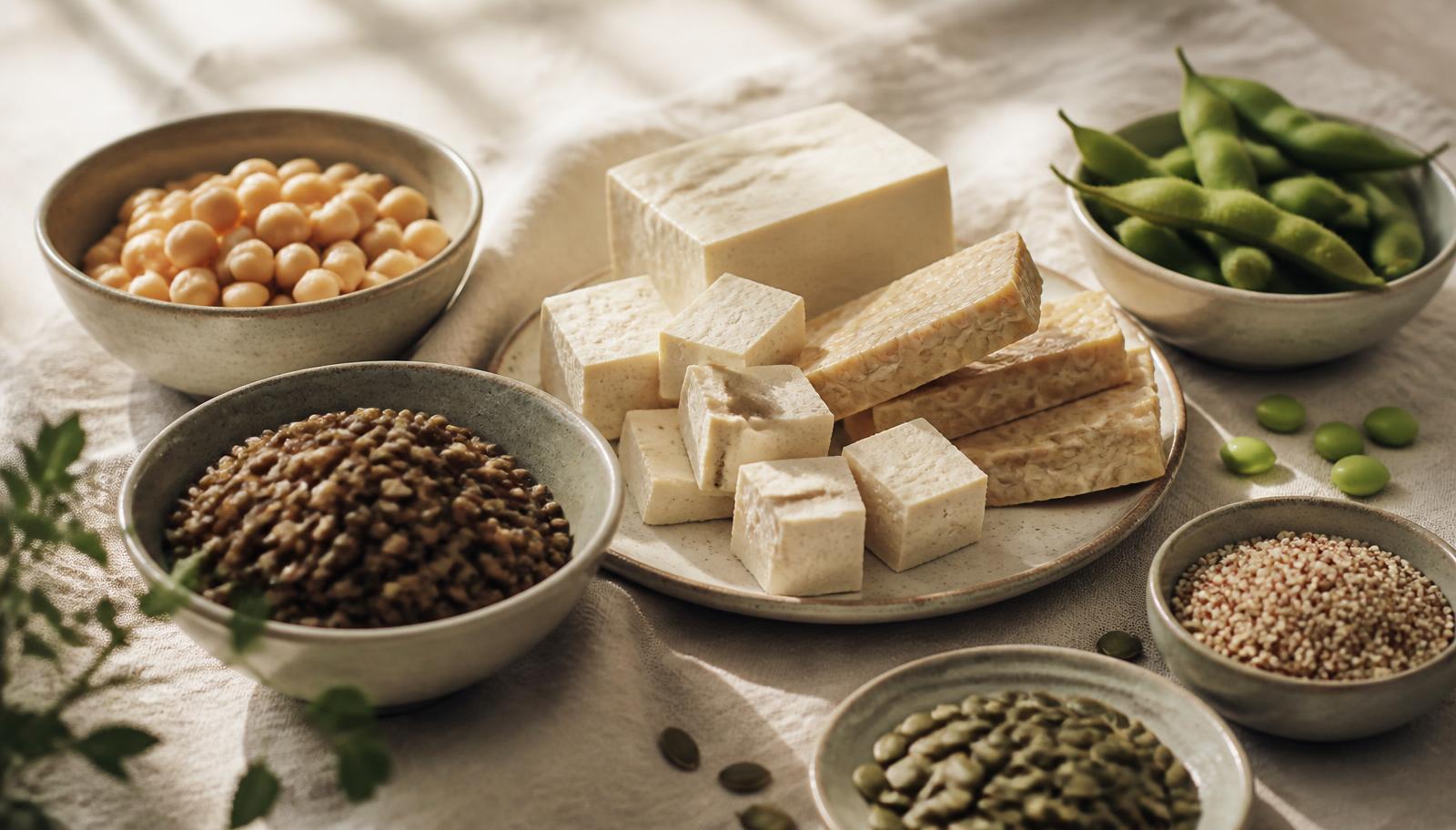
Soy is the best example. Its amino acid profile is much closer to that of animal proteins than that of many other plant proteins. Tofu, tempeh and fortified soy drinks are thus particularly interesting foods for building muscle mass without consuming animal products.
More broadly, it's worth remembering that a meal is almost never made up of a single food. The body constantly receives proteins from different sources, which complement each other over the course of the day.
Do plant proteins need to be combined?
For decades, one recommendation appeared consistently in nutrition books: you had to pair grains and legumes in the same meal to get a “complete” protein. This idea rested on a real observation — grains are generally poorer in lysine, while many legumes provide less methionine.
Today, this recommendation is largely nuanced. Research shows that the body doesn't operate meal by meal, but over the course of the whole day. Amino acids from different foods feed into the same pool used continuously for protein synthesis.
In other words, it isn't essential to perfectly combine every meal. It does, however, remain essential to vary your diet. A plant-based diet rich in legumes, soy, whole grains, nuts, seeds and fortified products largely covers the amino acid needs of most trainees.
Dietary variety therefore matters far more than seeking a perfect combination on every plate.
Can plant proteins really help build muscle?
The answer is yes, provided you respect three simple principles: consume enough protein across the whole day, follow progressive resistance training, and build a diverse enough diet to cover essential amino acid needs.
When these conditions are met, research shows that a plant-based diet can effectively build muscle mass. This doesn't mean all proteins are perfectly equal: animal proteins generally remain more concentrated in leucine and more digestible. But these differences become much less important once daily intake is adequate.
For vegan athletes, some researchers even recommend a safety margin of roughly 10 to 20% above usual recommendations to account for sometimes slightly lower digestibility. This strategy remains simple to implement and doesn't call into question a plant-based diet's ability to support performance or hypertrophy.
In practice
If your goal is to build muscle mass, current recommendations can be summed up simply.
If you consume animal proteins: aim generally for 1.6 to 2.2 g of protein per kilogram of body weight per day, spread across several meals. The overall quality of your diet matters more than the choice of any single food.
If you're vegetarian: the same protein targets apply. Vary your protein sources regularly; eggs and dairy products generally make it easier to hit your targets.
If you're vegan: the same principles remain valid. Favour foods naturally rich in protein such as soy, tofu, tempeh or legumes, and aim, if needed, for the upper end of the range (up to 20% more) to compensate for sometimes lower digestibility. A plant-based protein powder can be a practical solution when it becomes difficult to meet your needs through food alone.
Conclusion
The debate pitting animal proteins against plant proteins is often presented as a choice between effectiveness and compromise. The scientific data tell a different story.
Animal proteins retain certain nutritional advantages, notably better digestibility and a higher leucine content. These characteristics explain why they sometimes stimulate protein synthesis more strongly after a single meal. But building muscle doesn't depend on a single meal: it depends on the quality of the diet repeated day after day, total protein intake, training progression and recovery.
A well-thought-out plant-based diet meets these requirements. For most people, the question is therefore no longer choosing between animal and plant proteins, but building a diet that can be followed consistently, rich enough in protein, and suited to their goals.
In nutrition as in training, consistency almost always delivers more results than perfection.
Frequently asked questions
Scientific references
- 1.Morton RW, Murphy KT, McKellar SR, et al. A Systematic Review, Meta-analysis and Meta-regression of Protein Supplementation on Resistance Training-Induced Gains in Muscle Mass and Strength.
- 2.Lim MT, Pan BJ, Toh DWK, et al. Animal Protein versus Plant Protein in Supporting Lean Mass and Muscle Strength: A Systematic Review and Meta-Analysis of Randomized Controlled Trials.
- 3.Phillips SM. Current Concepts and Unresolved Questions in Dietary Protein Requirements and Supplements in Adults.
- 4.FAO. Dietary Protein Quality Evaluation in Human Nutrition (DIAAS).
About the author
Daniel Reyes
Registered dietitian-nutritionist
Daniel guides amateur and professional athletes towards nutrition they can actually apply, and reviews ORYX's food and supplement coverage.
Read next
The weekly letter
One calm read, every Sunday
One essay and a short selection of studies worth your attention. No promotions, no urgency, no noise.