Dumbbells or machines: which should you choose?
Dumbbells or machines: which is the best choice for building strength and muscle mass? Discover what scientific research shows and how to choose according to your goals.
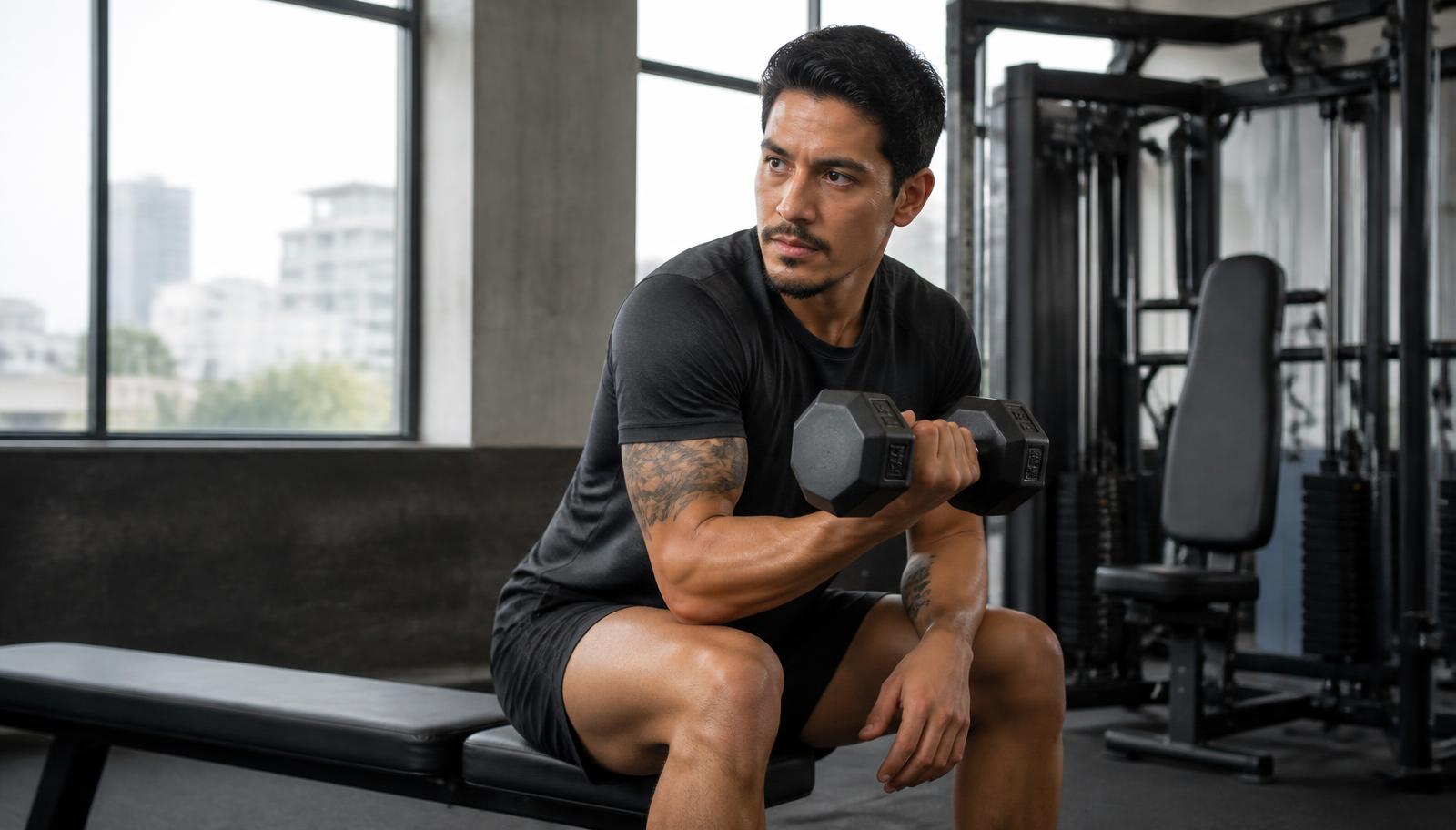
Dumbbells or machines: which should you choose?
Whether you're starting strength training or looking to optimise your performance, one question comes up regularly: should you prioritise dumbbells or machines?
Both approaches have advantages, but also limitations. Yet many misconceptions persist. Some claim dumbbells are always superior because they engage stabiliser muscles more. Others believe machines are less effective for building muscle mass.
What does scientific research actually show?
Current data indicate that neither tool is systematically superior to the other. Their effectiveness depends mainly on your level, your goals, the exercises chosen and how they are incorporated into your programme.
Understanding their differences therefore allows you to choose the option best suited to each situation rather than needlessly pitting two complementary methods against each other.
Why does this debate exist?
For a long time, free weights were considered the only "real" form of strength training.
Conversely, machines were sometimes seen as reserved for beginners or people in rehabilitation.
This opposition is, however, largely exaggerated.
Today, scientific literature shows that both methods can produce excellent results when used within a properly designed training programme.
The choice therefore shouldn't be guided by beliefs, but by their usefulness in a given situation.
The advantages of dumbbells
Dumbbells offer great freedom of movement.
Each arm works independently, which helps reduce certain muscle imbalances and engages the muscles responsible for joint stabilisation more.
They also allow the trajectory to adapt naturally to each individual's build.
For some people, this improves joint comfort compared with a fixed trajectory.
Dumbbells also more easily replicate certain movements found in sport or daily life.
The limits of dumbbells
This freedom of movement also demands more control.
Technique is often harder to master, especially for beginners.
When loads become very heavy, maintaining good stability can also become the limiting factor even before the targeted muscle is fully fatigued.
In some exercises, setting up or handling very large dumbbells can also become impractical.
The advantages of machines
Machines offer a guided trajectory.
This stability reduces coordination demands and allows more effort to be concentrated on the targeted muscle.
They are particularly appealing:
for beginners;
during rehabilitation;
when fatigue is significant;
for training closer to muscular failure with more safety, a concept detailed in "Is muscular failure really necessary?".
Machines also allow you to move quickly between exercises without having to handle several different loads.
The limits of machines
Not all machines suit all body types.
Some impose a trajectory that can be less comfortable for certain people.
They also engage stabiliser muscles less in certain exercises.
Finally, not all gyms have the same equipment, which sometimes limits choice.
What the scientific literature actually shows
Research comparing free weights and machines shows that both methods can increase strength and muscle mass when used with comparable training volume.
Some differences appear depending on the exercise.
Strength gains are generally more specific to the equipment used during training. Someone who trains mainly with dumbbells will progress more on dumbbell exercises, while someone who mainly uses machines will mostly improve their performance on those.
Regarding hypertrophy, the observed differences generally remain small when intensity and volume are comparable — a finding consistent with what "How many reps should you do to build muscle?" shows.
In other words, equipment choice often influences results less than the overall quality of the programme.
Which choice suits your goal?
Building muscle mass
Both options are effective.
The key is applying progressive overload, sufficient volume, and an appropriate proximity to muscular failure.
Building strength
Dumbbells help improve coordination and movement control.
Machines nonetheless remain useful for increasing training volume without accumulating as much technical fatigue.
Starting strength training
Machines often make learning movements easier thanks to their stability.
Dumbbells can then gradually be introduced to further develop coordination.
Preventing or managing certain pain
Depending on the injury or limitation, a machine can sometimes offer a more comfortable trajectory.
In other cases, dumbbells make it possible to adapt the movement to the person's build.
There is therefore no universal answer.
Should you choose one or the other?
Probably not.
In most well-constructed programmes, the two tools are complementary.
For example:
dumbbell bench press;
machine rows;
leg press;
dumbbell shoulder press;
leg curl;
cable lateral raises.
This combination lets you enjoy the advantages of each type of equipment while limiting their drawbacks.
Practical recommendations
For most people:
use dumbbells to develop coordination and free movement;
use machines to add training volume with greater stability;
above all, choose exercises you can perform with good technique;
progressively increase loads, whatever equipment you use;
don't consider one tool as systematically superior to the other.
Conclusion
The debate between dumbbells and machines often pits against each other two tools that pursue the same goal: effectively stimulating muscles.
Scientific data show that neither method is systematically superior to the other for building muscle mass or strength.
Dumbbells offer more freedom of movement and engage coordination more strongly, while machines provide stability, safety and ease of execution.
Rather than picking a side, the most effective strategy is generally to use each tool at the moment it delivers the most benefit.
In strength training, it isn't the equipment that determines your results, but the quality of your training as a whole.
Frequently asked questions
Scientific references
- 1.Haugen ME, Vårvik FT, Larsen S, et al. Effect of Free-Weight vs. Machine-Based Strength Training on Maximal Strength, Hypertrophy and Jump Performance: A Systematic Review and Meta-Analysis. BMC Sports Science, Medicine and Rehabilitation, 2023;15:103.
- 2.Schwanbeck SR, Cornish SM, Barss T, Chilibeck PD. Effects of Training with Free Weights versus Machines on Muscle Mass, Strength, Free Testosterone, and Free Cortisol Levels. Journal of Strength and Conditioning Research, 2020;34(7):1851-1859.
- 3.Schoenfeld BJ, Grgic J, Ogborn D, Krieger JW. Strength and Hypertrophy Adaptations Between Low- vs. High-Load Resistance Training: A Systematic Review and Meta-analysis. Journal of Strength and Conditioning Research, 2017;31(12):3508-3523.
- 4.Heidel KA, Novak ZJ, Dankel SJ. Machines and Free Weight Exercises: A Systematic Review and Meta-analysis Comparing Changes in Muscle Size, Strength, and Power. Journal of Sports Medicine and Physical Fitness, 2022;62(8):1061-1070.
About the author
Elena Marchetti
Strength coach, MSc in exercise physiology
Elena has coached strength practitioners and endurance athletes for fourteen years, and writes about the space between research and the gym floor.
Read next
The weekly letter
One calm read, every Sunday
One essay and a short selection of studies worth your attention. No promotions, no urgency, no noise.