What equipment should you get on a small budget?
Discover what equipment to choose to start strength training on a small budget and invest wisely in genuinely useful gear.
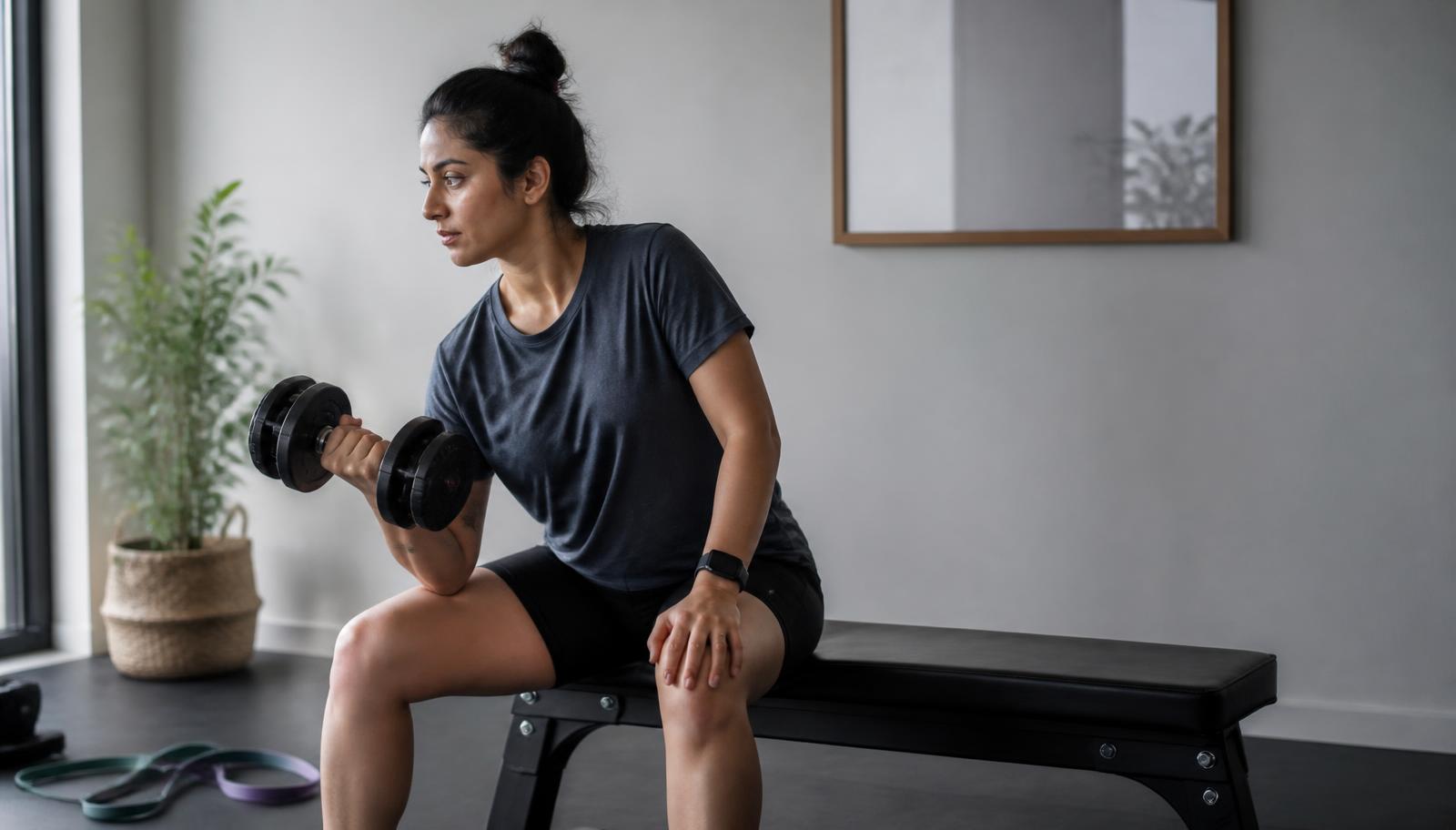
What equipment should you get on a small budget?
Starting strength training doesn't necessarily mean investing in a high-end gym membership or buying a large amount of equipment.
Today, a few well-chosen pieces of equipment are already enough for a complete workout and years of progress.
Yet many beginners make the same mistake: buying lots of accessories before even building a consistent training routine.
Research shows, however, that progress depends above all on the quality of the programme, progressive overload and consistency, far more than on the amount of equipment available.
So which equipment actually offers the best value for money when starting out on a limited budget?
Do you need a lot of equipment to progress?
No.
Most of the most effective exercises use little equipment.
Movements such as the bench press, rows, squats, lunges or shoulder press can all be performed with a few dumbbells and a bench.
Research shows that results depend mainly on training quality and load progression, rather than on the amount of equipment available.
In other words, a few well-used pieces of equipment beat a room full of rarely used accessories.
The best investments
Adjustable dumbbells
For most beginners, adjustable dumbbells are the best investment.
They allow dozens of different exercises while taking up very little space.
They also offer load progression, essential for continuing to build strength and muscle mass over time — an arbitration detailed in "Dumbbells or machines: which should you choose?".
An adjustable bench
If your budget allows, an incline bench is probably the second-best purchase.
It considerably increases the number of exercises available:
bench press;
incline press;
rows;
shoulder exercises;
arm work.
Choose a stable model, sturdy enough to keep pace with your progress.
Resistance bands offer excellent value for money.
They notably allow you to:
improve your warm-up;
assist pull-ups;
add resistance to certain exercises;
keep training while travelling.
They complement dumbbells effectively, but generally don't replace them for building strength over the long term.
Equipment that can wait
When budget is limited, certain purchases can be postponed.
This is notably the case for:
strength training machines;
expensive cardio equipment;
highly specialised accessories;
equipment designed for a single exercise.
This equipment can become worthwhile later, but it is rarely essential for a beginner.
How should you allocate your budget?
A simple strategy is to invest progressively.
For example:
Small budget
adjustable dumbbells;
resistance bands;
a floor mat.
Intermediate budget
Then add:
an adjustable bench;
a pull-up bar.
More comfortable budget
You can then consider:
a squat rack;
an olympic barbell;
weight plates;
a cable pulley system.
This progression avoids unnecessary spending while building a gym that evolves with you — an approach detailed in "How do you build a home gym?".
The most common mistakes
One of the most common mistakes is favouring quantity over quality.
Sturdy equipment used for several years is often a better investment than several accessories with a short lifespan.
Another mistake is buying equipment purely because it's popular on social media.
Finally, some beginners spend more of their budget on accessories than on the equipment they actually use during their sessions.
What if you train using bodyweight only?
Bodyweight training is an excellent way to get started.
Push-ups, pull-ups, squats, lunges and dips can already build strength and muscle mass.
However, as level progresses, adding external load generally makes progressive overload easier and helps continue stimulating muscles effectively.
Practical recommendations
For most beginners:
favour a few versatile pieces of equipment;
invest progressively;
choose good-quality equipment;
avoid impulse purchases;
build your equipment around your training programme — see "What training frequency is ideal?".
A simple setup used regularly will always produce more results than expensive equipment rarely used.
Conclusion
Building an effective training space doesn't require a large budget.
Research shows that a limited number of versatile pieces of equipment is enough to effectively build strength and muscle mass when the programme is well designed.
By starting with a few essential investments, then progressively expanding your equipment according to your needs, you can build a functional home gym without excessive spending.
Ultimately, the best equipment is the equipment you use regularly to progress, session after session.
Frequently asked questions
Scientific references
- 1.American College of Sports Medicine. ACSM's Guidelines for Exercise Testing and Prescription.
- 2.American College of Sports Medicine Position Stand. Progression Models in Resistance Training for Healthy Adults.
- 3.Schoenfeld BJ. Science and Development of Muscle Hypertrophy.
- 4.Grgic J, Schoenfeld BJ, Davies TB, et al. Effect of Resistance Training Performed to Repetition Failure or Non-Failure on Muscular Strength and Hypertrophy: A Systematic Review and Meta-analysis.
About the author
Elena Marchetti
Strength coach, MSc in exercise physiology
Elena has coached strength practitioners and endurance athletes for fourteen years, and writes about the space between research and the gym floor.
Read next
The weekly letter
One calm read, every Sunday
One essay and a short selection of studies worth your attention. No promotions, no urgency, no noise.