Do resistance bands replace weights?
Can resistance bands really replace dumbbells and machines? Discover what research shows about strength, hypertrophy and their limits.
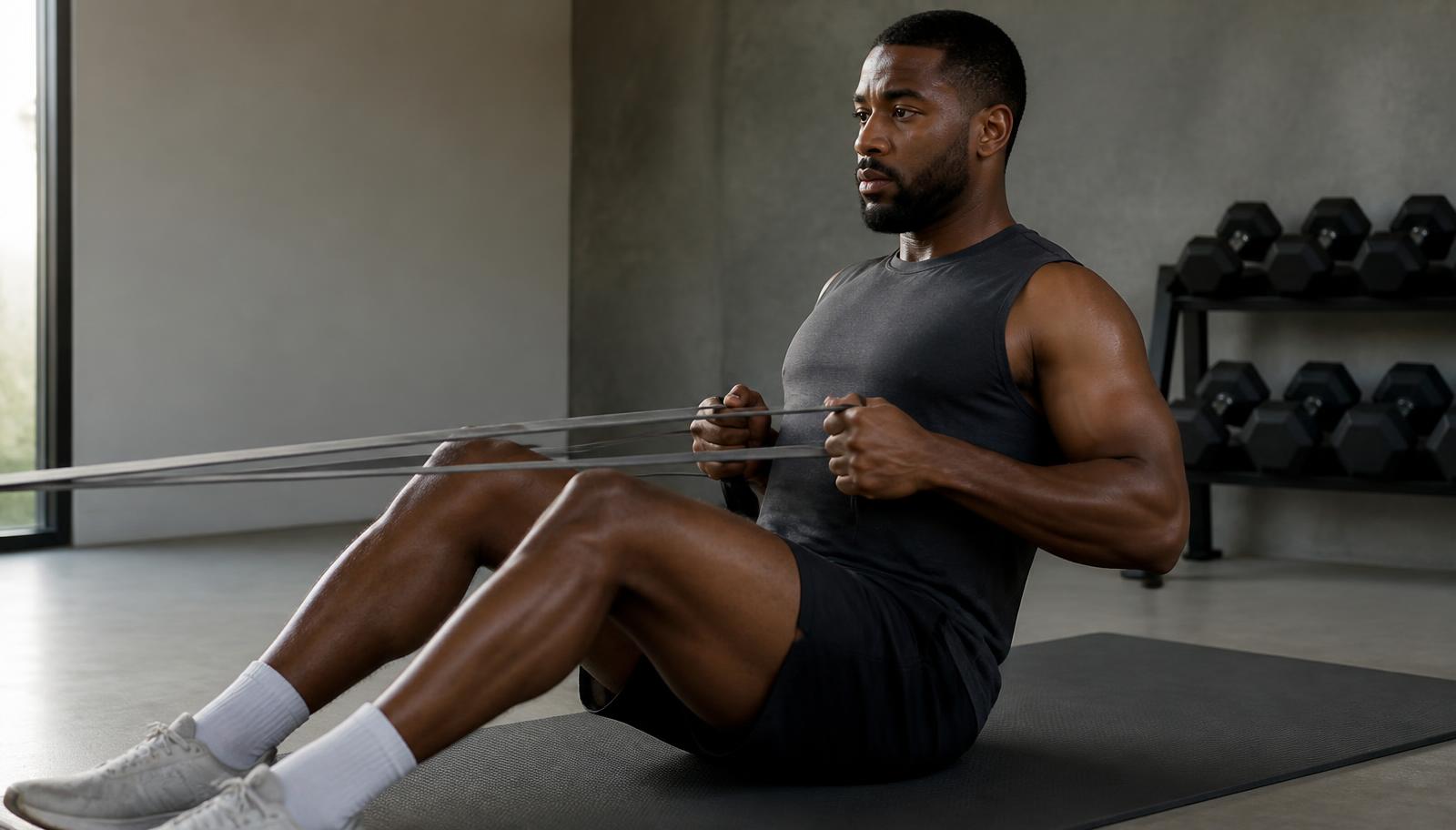
Do resistance bands replace weights?
Resistance bands have become extremely popular in recent years. Compact, inexpensive and easy to carry, they are used at home, in gyms, in rehabilitation, and even by elite athletes.
This popularity brings a common question: can resistance bands truly replace dumbbells, barbells or machines for building strength and muscle mass?
Some claim they are just as effective as traditional weights, while others believe they don't allow for serious progress.
What does the scientific research actually show?
Current data indicate that resistance bands can be an effective tool for building strength and muscle mass, particularly for beginners and intermediate lifters. However, they don't systematically replace free weights or machines in every situation.
Their value depends mainly on the exercises performed, the lifter's level, and how they are used within the training programme.
How do resistance bands work?
Unlike free weights, the resistance provided by an elastic band increases progressively as it is stretched.
In other words, the further the band stretches, the greater the resistance becomes.
This characteristic slightly alters the resistance profile of certain exercises.
For example, during a biceps curl, the load becomes progressively heavier as the forearm approaches the shoulder.
This differs from dumbbells, whose resistance depends mainly on gravity — a detailed comparison in "Dumbbells or machines: which should you choose?".
What the scientific literature shows
Research comparing resistance bands with free weights shows that both methods can improve strength and stimulate hypertrophy, provided training volume and intensity are comparable.
Several systematic reviews report that observed differences generally remain modest, particularly among beginners and recreational lifters — the scope of this type of synthesis is explained in "What is a meta-analysis?".
For more experienced athletes, or when a very high level of strength is sought, free weights often offer more scope for continuing to progressively increase loads.
In other words, resistance bands are effective, but they don't fully replace every training scenario.
The advantages of resistance bands
Bands offer several strengths.
They are:
inexpensive;
easy to carry;
suited to small spaces;
quiet;
versatile.
They also allow for a wide range of full-body exercises.
In rehabilitation, they offer progressive resistance that is often well tolerated and are widely used by healthcare professionals.
Their limits
Despite their qualities, bands also have certain limitations.
Resistance varies throughout the movement, which doesn't necessarily suit every exercise.
It can also be harder to measure the load used precisely and to apply progressive overload as easily as with dumbbells or a barbell.
Finally, when the goal is to develop a very high level of maximal strength, free weights generally remain more suitable.
In which situations are they particularly useful?
Resistance bands are an excellent choice:
for starting out in strength training;
for training at home;
while travelling;
as a complement to free weights;
during certain rehabilitation phases;
for warming up or mobility work.
They also make it possible to add resistance to certain bodyweight exercises, such as push-ups or squats — see also "What equipment should you get on a small budget?".
Can bands fully replace weights?
For some people, yes.
A beginner can effectively build strength and muscle mass for several months using only resistance bands if their programme is well constructed.
However, as level progresses, it often becomes worthwhile to incorporate dumbbells, a barbell or machines to make it easier to progress loads and expand training options.
In other words, fully replacing weights isn't always necessary, but combining them is often the most complete solution.
Practical recommendations
For most people:
use bands as a complementary tool rather than a systematic replacement;
choose bands of different resistances so you can keep progressing;
apply the same progressive overload principles as with weights;
favour exercises you can perform with good technique;
adapt equipment to your goals and training environment.
Conclusion
Resistance bands are neither a gadget nor a miracle solution.
Research shows they can effectively build strength and muscle mass when used within a well-designed programme.
They offer an excellent solution for training at home, complementing weight training, or maintaining physical activity while travelling.
However, for lifters seeking a high level of strength or wishing to apply progressive overload over the long term, free weights and machines retain several advantages.
In practice, the best strategy is generally to use each tool for what it does best rather than pitting two complementary methods against each other.
Frequently asked questions
Scientific references
- 1.American College of Sports Medicine. Progression Models in Resistance Training for Healthy Adults.
- 2.Lopes JSS, Machado AF, Micheletti JK, et al. Effects of Training With Elastic Resistance Versus Conventional Resistance on Muscular Strength: A Systematic Review and Meta-analysis.
- 3.Schoenfeld BJ. Science and Development of Muscle Hypertrophy.
- 4.Colado JC, Garcia-Masso X, Pellicer M, et al. A Comparison of Elastic Tubing and Isotonic Resistance Exercises.
About the author
Elena Marchetti
Strength coach, MSc in exercise physiology
Elena has coached strength practitioners and endurance athletes for fourteen years, and writes about the space between research and the gym floor.
Read next
The weekly letter
One calm read, every Sunday
One essay and a short selection of studies worth your attention. No promotions, no urgency, no noise.