How do you build a home gym?
Discover how to build an effective home gym, which equipment to prioritise according to your budget, and what is genuinely essential for progress.
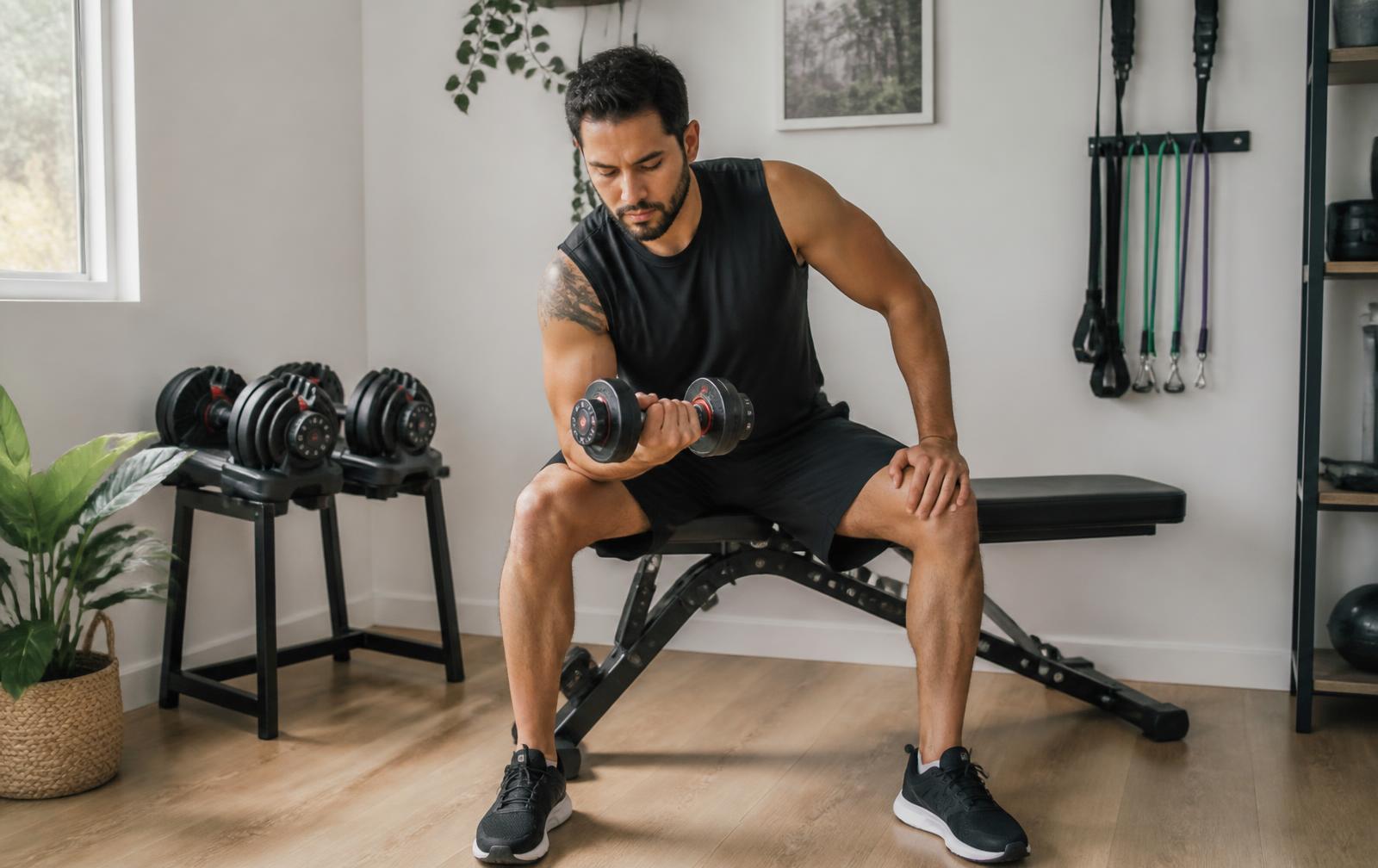
How do you build a home gym?
Building a home gym has never been more accessible. A few dumbbells, a bench and a little space are now enough to perform most of the exercises needed to build strength and muscle mass.
Yet many people think you need to invest several thousand pounds to get results comparable to those of a commercial gym.
Scientific research shows, however, that it is above all training quality, load progression and consistency that determine results, far more than the amount of equipment available.
So what equipment should you actually buy? Which investments are essential, and which can wait?
The aim of this article is to help you build an effective, scalable home gym suited to your budget.
How much space do you really need?
Contrary to popular belief, a large room is not essential.
For most people, 6 to 10 m² is more than enough to set up a functional home gym.
A garage, an unused bedroom, or even a corner of the living room can work, as long as the space allows the main movements to be performed safely.
A well-organised space is often more important than a large area cluttered with rarely used machines.
What equipment is essential?
Adjustable dumbbells
If you could buy only one piece of equipment, adjustable dumbbells would probably be the best choice.
They allow dozens of different exercises while taking up very little space.
Their main advantage is offering load progression without having to buy several pairs of dumbbells — a point developed in "Dumbbells or machines: which should you choose?".
An adjustable bench
An incline bench considerably increases the number of exercises available.
Bench press, incline press, rows, shoulder or arm exercises: a single bench allows for many variations while staying compact.
Choose a stable model, sturdy enough, and adjustable across several inclines.
Inexpensive, lightweight and easy to store, they allow you to:
warm up the joints;
add resistance;
assist certain movements such as pull-ups;
train even when equipment is limited.
They make an excellent complement, but rarely fully replace free weights for building strength over the long term.
A floor mat
Often overlooked, it improves comfort during floor exercises, stretching or mobility work.
It also protects the flooring in certain rooms.
Useful equipment according to your budget
With a limited budget, a simple combination is often enough:
adjustable dumbbells;
resistance bands;
a floor mat.
This set-up already allows for a complete workout.
Intermediate budget
You can then add:
an adjustable bench;
a pull-up bar;
a few extra weight plates if needed.
This set-up covers the needs of most people.
Higher budget
When your budget is more generous, several pieces of equipment become worthwhile:
a squat rack (power rack);
an olympic barbell;
olympic weight plates;
a cable pulley system;
a rowing machine or bike for cardiovascular work.
This equipment expands training options without being essential for progress.
The most common mistakes
Many people invest first in an expensive machine.
Yet a machine often only allows a limited number of movements to be trained effectively.
For the same budget, adjustable dumbbells generally offer far greater versatility.
Another mistake is buying many accessories before even building a consistent training routine — consistency matters more, as noted in "What training frequency is ideal?".
Finally, some people prioritise the appearance of their gym over the quality of the equipment actually used.
Are machines necessary?
Not necessarily.
Research shows that free weights can already effectively build strength and muscle mass when used within a well-constructed programme.
Machines become especially interesting when you want to increase exercise variety or want extra comfort.
For most people, they are more of a luxury than a necessity.
How can you optimise your space?
A few simple principles can save a lot of space:
favour multi-function equipment;
use wall storage for accessories;
leave enough space around the training area;
protect the floor with rubber tiles if loads are heavy.
A clear space improves not only comfort but also safety.
Practical recommendations
For most people:
start with a few versatile pieces of equipment;
invest progressively according to your needs;
favour quality over quantity;
choose equipment that can grow with your progress;
build your gym around your training programme, not the other way round.
A simple gym used regularly will always be more effective than a perfectly equipped one that is rarely used.
Conclusion
Building a home gym isn't about accumulating as much equipment as possible.
Research and experience show that a simple set-up, comprising a few versatile pieces of equipment, is already enough to perform most of the exercises needed to build strength and muscle mass.
By investing progressively in quality equipment and prioritising fundamental movements, you can create an effective, durable gym suited to your budget.
Ultimately, it isn't the machines that determine your results, but the quality of your training, your consistency, and your progression over time.
Frequently asked questions
Scientific references
- 1.American College of Sports Medicine. ACSM's Guidelines for Exercise Testing and Prescription.
- 2.Schoenfeld BJ. Science and Development of Muscle Hypertrophy.
- 3.American College of Sports Medicine Position Stand. Progression Models in Resistance Training for Healthy Adults.
- 4.Grgic J, Schoenfeld BJ, Davies TB, et al. Effect of Resistance Training Performed to Repetition Failure or Non-Failure on Muscular Strength and Hypertrophy: A Systematic Review and Meta-analysis.
About the author
Elena Marchetti
Strength coach, MSc in exercise physiology
Elena has coached strength practitioners and endurance athletes for fourteen years, and writes about the space between research and the gym floor.
Read next
The weekly letter
One calm read, every Sunday
One essay and a short selection of studies worth your attention. No promotions, no urgency, no noise.